


An equity fund is a type of mutual fund that invests at least 65% of its money in company shares (stocks). It aims to generate long-term wealth by investing in businesses across different sectors. Equity funds are suitable for investors with financial goals of five years or more and are professionally managed by fund managers.
- Every equity fund is a mutual fund.
- But not every mutual fund is an equity fund.
Some mutual funds invest in bonds, gold, or a mix of different assets instead of stocks.
Quick Summary
- Equity funds invest at least 65% of their money in company shares.
- They are best for financial goals that are 5 years or more away.
- Returns are not guaranteed because they depend on the stock market.
- You can start investing through a SIP with as little as ₹500 per month.
How Equity Mutual Funds Work

When you invest in an equity mutual fund, your money is combined with the money of thousands of other investors. This large pool of money is then invested in different company shares by a professional fund manager.
The fund manager works for an Asset Management Company (AMC), which manages the mutual fund on behalf of investors.
Think of it like this:
Imagine 100 people contribute money to buy a large commercial property. Each person owns a small share of that property instead of buying an entire building alone. If the property’s value increases, everyone’s investment grows according to their share.
Equity mutual funds work similarly.
Instead of investing in one company, your money is spread across many companies.
Some well-known AMCs in India include:
- HDFC Mutual Fund
- SBI Mutual Fund
- ICICI Prudential Mutual Fund
The fund manager decides:
- Which companies to invest in
- How much money to invest in each company
- When to buy or sell shares
This helps investors who don’t have the time or knowledge to pick stocks themselves.
Why Do Investors Choose Equity Funds in Mutual Funds?
Most investors choose equity funds because they offer the potential to create higher long-term wealth than many traditional investment options.
Along with better growth opportunities, they also provide diversification and professional management, making them a convenient choice for beginners.
Potential for Long-Term Wealth Creation
Historically, equity has been one of the best-performing asset classes over long periods such as 10, 15, or 20 years.
Although stock markets go through ups and downs, investors who stay invested for the long term have generally earned better returns than those who invested only in traditional savings products.
Remember, higher returns are never guaranteed, but staying invested for longer has usually rewarded patient investors.
Inflation-Beating Returns
Inflation slowly reduces the purchasing power of your money.
For example, if inflation is around 6% and your Fixed Deposit earns 6–7%, your money is only just keeping up with rising prices.
Over long periods, equity funds have often delivered returns that are higher than inflation. This helps your money grow in real terms instead of simply maintaining its value.
Professional Fund Management
Not everyone has the time to analyse company financial statements or follow stock market news every day.
That’s where professional fund managers help.
They have research teams that study companies, monitor market trends, and make investment decisions on your behalf.
This allows you to invest in the stock market without becoming an expert yourself.
Diversification Across Multiple Companies
One of the biggest advantages of equity funds is diversification.
Instead of investing all your money in a single company, your investment is spread across many companies.
For example, if a fund holds 50 different stocks, poor performance by one company is less likely to have a major impact because the remaining companies can balance the overall performance.
This reduces the risk compared to buying individual shares.
Easy to Start with SIP
You don’t need a large amount to begin investing. Most mutual fund companies allow SIP investments starting from ₹500 per month.
This makes equity funds affordable for students, salaried employees, and first-time investors.
Types of Equity Funds in Mutual Funds

Not all equity funds are the same.
Some invest in large and well-established companies, while others focus on smaller companies with higher growth potential. Every type of equity fund comes with a different level of risk and return.
Understanding these categories will help you choose the right fund based on your financial goals and risk tolerance.
Large Cap Equity Funds
Large Cap Funds invest in the top 100 companies in India based on their market value.
These companies are usually industry leaders with a strong business history. Examples include companies like Reliance Industries, TCS, HDFC Bank, and Infosys.
Since these companies are well-established, large cap funds are generally more stable than other equity funds. Although their returns may be lower than mid-cap or small-cap funds during strong market rallies, they also tend to fall less during market downturns.
Suitable for:
- First-time investors
- Conservative investors
- Long-term wealth creation
- Investors looking for relatively lower risk
Mid Cap Equity Funds
Mid Cap Funds invest in companies ranked 101 to 250 by market capitalization.
These companies are usually in the growth stage. They have the potential to become large companies in the future.
Because of this, mid-cap funds can generate higher returns than large-cap funds. However, they also experience bigger price fluctuations.
If you’re comfortable taking moderate risk for potentially higher returns, mid-cap funds can be a good option.
Suitable for:
- Investors with a 7–10 year investment horizon
- Investors willing to accept moderate to high risk
- Wealth creation over the long term
Small Cap Equity Funds
Small Cap Funds invest in companies ranked 251 and beyond by market capitalization.
These are relatively smaller businesses that have significant growth potential.
However, they are also the most volatile. During market corrections, small-cap funds can fall sharply. At the same time, they may deliver excellent returns when markets perform well.
These funds require patience and a long investment horizon.
Suitable for:
- Experienced investors
- Investors with high risk tolerance
- Long-term goals of 10 years or more
Flexi Cap and Multi Cap Funds
Both Flexi Cap and Multi Cap Funds invest across companies of different sizes, but there is an important difference.
Flexi Cap Funds
The fund manager has complete freedom to invest in large-cap, mid-cap, or small-cap companies depending on market opportunities.
This flexibility allows the fund manager to adjust the portfolio as market conditions change.
Multi Cap Funds
Multi Cap Funds are required to invest a minimum percentage of their money in large-, mid-, and small-cap companies.
This ensures balanced exposure across all company sizes.
Suitable for:
- Investors who want diversification in a single fund
- Beginners looking for an all-round equity fund
ELSS (Tax Saving Equity Funds)
ELSS stands for Equity Linked Savings Scheme.
It is the only type of equity mutual fund that offers tax benefits under Section 80C of the Income Tax Act.
You can claim a tax deduction of up to ₹1.5 lakh in a financial year by investing in ELSS, subject to the applicable tax rules.
However, ELSS comes with a mandatory lock-in period of 3 years, which means you cannot withdraw your investment before that.
Suitable for:
- Salaried individuals looking to save tax
- Long-term investors
- Beginners who want both tax benefits and equity exposure
Sectoral and Thematic Equity Funds
These funds invest only in a specific sector or a particular investment theme.
For example:
- Banking Funds
- IT Funds
- Pharma Funds
- Infrastructure Funds
- Consumption Funds
Since these funds focus on a limited number of industries, they carry higher risk.
If that sector performs well, returns can be excellent. But if the sector underperforms, your investment may also suffer.
Because of this concentration risk, these funds are generally not recommended for beginners.
Suitable for:
- Experienced investors
- Investors who understand specific sectors
- Those willing to take higher risk

How Does an Equity Fund Generate Returns?
The main goal of an equity fund is to increase the value of your investment over time.
It does this in two primary ways:
- Capital appreciation
- Dividend income
Let’s understand each of them.
Capital Appreciation
Capital appreciation simply means an increase in the value of the shares owned by the mutual fund.
For example, suppose a mutual fund buys shares of a company at ₹1,000.
After a few years, the share price rises to ₹1,500.
As the value of the fund’s investments increases, the Net Asset Value (NAV) of the mutual fund also increases.
As a result, the value of your investment grows.
This is the biggest source of returns for most equity mutual funds.
Dividend Income
Some companies distribute a part of their profits to shareholders as dividends.
When the companies in a mutual fund’s portfolio pay dividends, the fund receives this income.
Depending on the option you have selected:
- In the Growth Option, the dividend is usually reinvested into the fund, helping your investment grow further.
- In the IDCW (Income Distribution cum Capital Withdrawal) Option, the dividend may be paid out to investors.
Most long-term investors prefer the Growth Option because it allows the power of compounding to work over time.
The Impact of NAV on Your Investment
Every mutual fund unit has a value called the Net Asset Value (NAV).
The NAV is calculated at the end of every trading day based on the total value of all the investments held by the fund.
Let’s understand this with a simple example.
Rohit is a 27-year-old software engineer in Pune.
He starts a ₹5,000 monthly SIP in a Large Cap Equity Fund.
His ₹5,000 is not invested in just one company.
Instead, the fund invests it across around 40 to 60 different companies according to the fund manager’s strategy.
When Rohit invests, he receives mutual fund units.
The price of each unit is called the Net Asset Value (NAV).
Suppose the NAV is ₹50 today.
His ₹5,000 investment buys:
₹5,000 ÷ ₹50 = 100 units
After one year, if the NAV increases to ₹60, then:
100 units × ₹60 = ₹6,000
So, Rohit’s investment has grown by ₹1,000.
A higher NAV simply means the value of your existing units has increased.
It does not mean the fund has become expensive like a company’s share price.
This is a common misunderstanding among beginners.
What Happens During Bull and Bear Markets?
Stock markets do not move in one direction all the time.
There are periods when markets rise and periods when they fall.
Bull Market
During a bull market:
- Stock prices generally rise.
- The NAV of equity funds also increases.
- Investors usually see positive returns in their portfolios.
Bear Market
During a bear market:
- Stock prices decline.
- The NAV of equity funds also falls.
- Your investment value may decrease temporarily.
This is completely normal.
Market ups and downs are a natural part of equity investing.
Many beginners panic during market falls and stop their SIPs or sell their investments. However, history shows that markets have recovered from every major correction over the long term.
That’s why equity funds are recommended only for investors with a long-term investment horizon.
Who Should Invest in Equity Funds?
Equity funds are a good choice for people who have long-term financial goals and are comfortable with short-term market ups and downs.
Since stock markets can be volatile in the short term, equity funds work best for goals that are at least five years away.
Let’s see who can benefit the most from investing in equity funds.
Investors with Long-Term Financial Goals
If your financial goal is several years away, equity funds can help you build wealth over time.
Some common long-term goals include:
- Retirement planning
- Children’s higher education
- Buying a house
- Building long-term wealth
- Financial independence
A longer investment period gives your money more time to grow and recover from temporary market declines.
Young Salaried Professionals
If you’ve recently started earning, this is one of the best times to begin investing in equity funds.
For example, someone who starts investing at the age of 25 or 30 has several decades before retirement.
This long investment horizon allows the power of compounding to work in your favour.
Even a small monthly SIP can grow into a significant amount over time if you stay invested consistently.
First-Time Investors Starting with SIP
Many beginners worry that they need a large amount of money to start investing.
The good news is that most equity mutual funds allow you to begin with a SIP of ₹500 or ₹1,000 per month.
For example, if you earn ₹60,000 per month, you can comfortably start with a SIP of ₹2,000–₹5,000 and gradually increase it as your income grows.
A SIP also helps you invest regularly without worrying about market timing.
Investors Who Can Handle Market Volatility
The value of equity funds does not increase every day.
There will be times when your investment may fall by 10%, 15%, or even 20% during market corrections.
If you can stay calm during these periods and continue investing instead of panicking, equity funds can be suitable for you.
Patience is one of the most important qualities of a successful equity investor.
Who Should Avoid Equity Funds?
Although equity funds are excellent for long-term investing, they are not suitable for everyone.
If your financial situation or goals don’t match the nature of equity investing, you should consider other investment options.
Short-Term Investors
If you need your money within the next 1 to 3 years, equity funds may not be the right choice.
For example:
- Wedding expenses next year
- Buying a car in two years
- Paying college fees soon
- Planning an international trip
Since markets can fall unexpectedly, your investment may be worth less when you need the money.
For short-term goals, debt funds or fixed deposits are generally more suitable.
People Who Need Guaranteed Returns
Equity funds are market-linked investments.
This means there is no guarantee of returns.
If you want complete certainty about your returns, options such as:
- Public Provident Fund (PPF)
- Fixed Deposits (FDs)
- Government Bonds
may be more appropriate.
Investors Without an Emergency Fund
Before investing in equity funds, it’s important to have an emergency fund.
An emergency fund helps you manage unexpected expenses like:
- Medical emergencies
- Job loss
- Urgent home repairs
- Family emergencies
If all your savings are invested in equity funds, you may be forced to withdraw money during a market downturn, leading to losses.
A good rule is to build an emergency fund covering 6–12 months of your living expenses before investing heavily in equity funds.
Risks of Investing in Equity Funds
Every investment comes with some level of risk, and equity funds are no exception. Understanding these risks helps you make better investment decisions and avoid unrealistic expectations.
Market Risk
Equity funds invest mainly in company shares. When the stock market falls, the value of these shares also declines. As a result, the NAV of the mutual fund may decrease, reducing the value of your investment.
Volatility During Market Crashes
Stock markets can experience sharp declines during economic crises or unexpected events.
For example, during the COVID-19 market crash in March 2020, many equity funds lost a significant part of their value within a short period.
However, investors who stayed invested during the recovery were able to benefit when markets bounced back.
Short-term volatility is a normal part of equity investing.
Sector and Economic Risks
Many factors can affect equity fund performance, including:
- Economic slowdown
- Rising interest rates
- Inflation
- Global events
- Political uncertainty
- Poor performance in specific industries
Even the best fund managers cannot completely avoid these market-wide risks.
Why Staying Invested Matters
One of the biggest mistakes beginners make is selling their investments whenever the market falls.
History shows that Indian stock markets have recovered from major market crashes, including those in 2008 and 2020, and eventually reached new highs.
This does not guarantee that future recoveries will follow the same pattern, but it highlights an important lesson:
Temporary market declines are a normal part of long-term investing.
If you panic and sell during a downturn, you may miss the recovery that often follows.
That’s why successful equity investing is less about predicting the market and more about staying invested for the long term.
Equity Fund vs Debt Fund: What’s the Difference?

Both equity funds and debt funds are types of mutual funds, but they invest in different assets and serve different purposes.
An equity fund mainly invests in company shares, while a debt fund invests in fixed-income securities like government bonds, treasury bills, and corporate bonds.
The right choice depends on your financial goals, investment horizon, and risk appetite.
| Factor | Equity Fund | Debt Fund |
| Where the money is invested | Company shares (stocks) | Bonds, government securities, and other fixed-income instruments |
| Risk Level | Moderate to High | Low to Moderate |
| Return Potential | Higher over the long term, but not guaranteed | Lower, but generally more stable |
| Ideal Investment Period | 5 years or more | Less than 3 years |
| Short-Term Volatility | High | Low |
| Best For | Long-term wealth creation | Emergency fund and short-term financial goals |
Which One Should You Choose?
The answer depends on your financial goal.
Choose an Equity Fund if:
- Your goal is at least 5 years away.
- You want long-term wealth creation.
- You are comfortable with short-term market fluctuations.
Choose a Debt Fund if:
- You need your money within the next few years.
- You want relatively stable returns.
- Protecting your capital is more important than earning higher returns.
A simple rule to remember:
- Goal within 3 years → Debt Fund
- Goal more than 5 years away → Equity Fund
Many investors use both equity and debt funds in their portfolio to balance risk and returns.
How to Choose the Right Equity Fund in Mutual Fund

With hundreds of equity mutual funds available in India, choosing one can feel confusing.
Instead of selecting a fund based only on recent returns, follow these simple steps to make a better decision.
Identify Your Financial Goals
Before choosing any fund, ask yourself:
Why am I investing?
Your goal will help determine the right type of equity fund.
For example:
- Retirement planning
- Buying a house
- Children’s education
- Long-term wealth creation
Having a clear goal also helps you decide how long you should stay invested.
Assess Your Risk Tolerance
Every investor has a different comfort level with risk.
Ask yourself:
- Can I stay invested if my portfolio falls by 20%?
- Will I panic during market corrections?
- Am I comfortable with short-term volatility?
If market fluctuations make you uncomfortable, consider starting with Large Cap Funds or Flexi Cap Funds instead of small-cap funds.
Choose the Right Fund Category
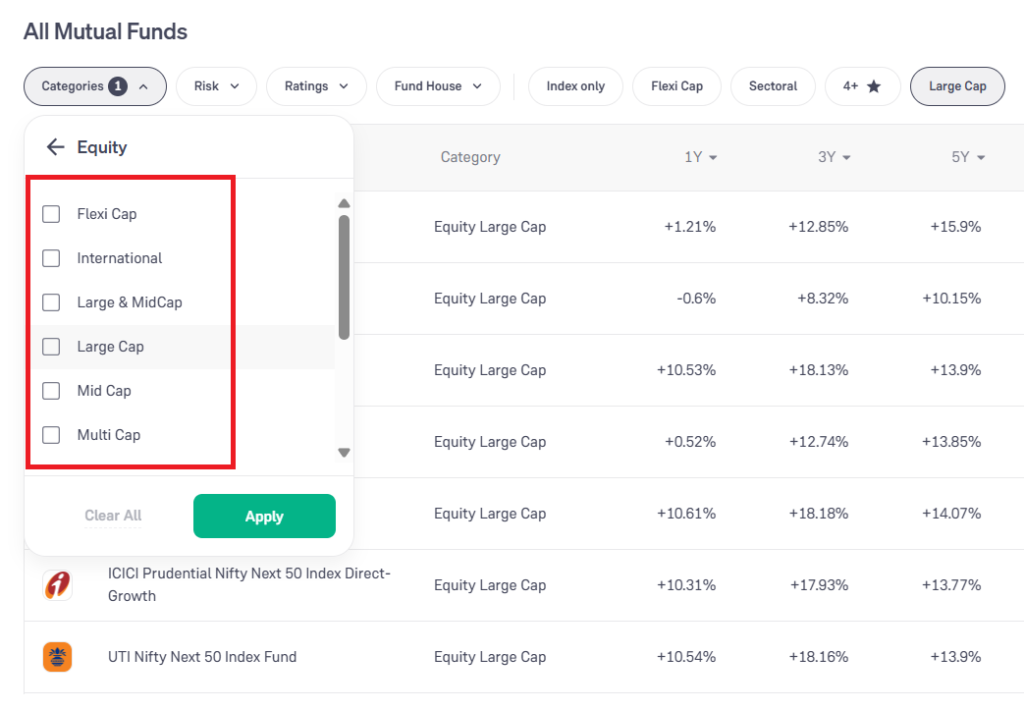
Different fund categories suit different investors.
As a beginner, you can consider:
- Large Cap Funds for relatively stable growth
- Flexi Cap Funds for diversified exposure
- Index Funds for low-cost investing
You can explore Mid Cap or Small Cap Funds later as your investment experience grows.
Check the Expense Ratio
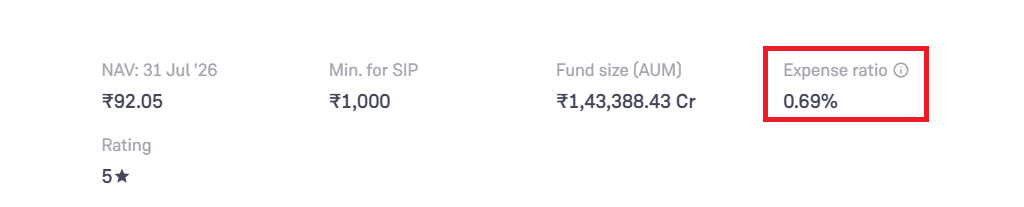
The expense ratio is the annual fee charged by the Asset Management Company (AMC) for managing the fund.
Although the percentage may look small, even a difference of 0.5% to 1% can make a noticeable impact on your returns over many years.
Comparing expense ratios is a simple way to evaluate similar funds.
Review the Fund Manager’s Track Record
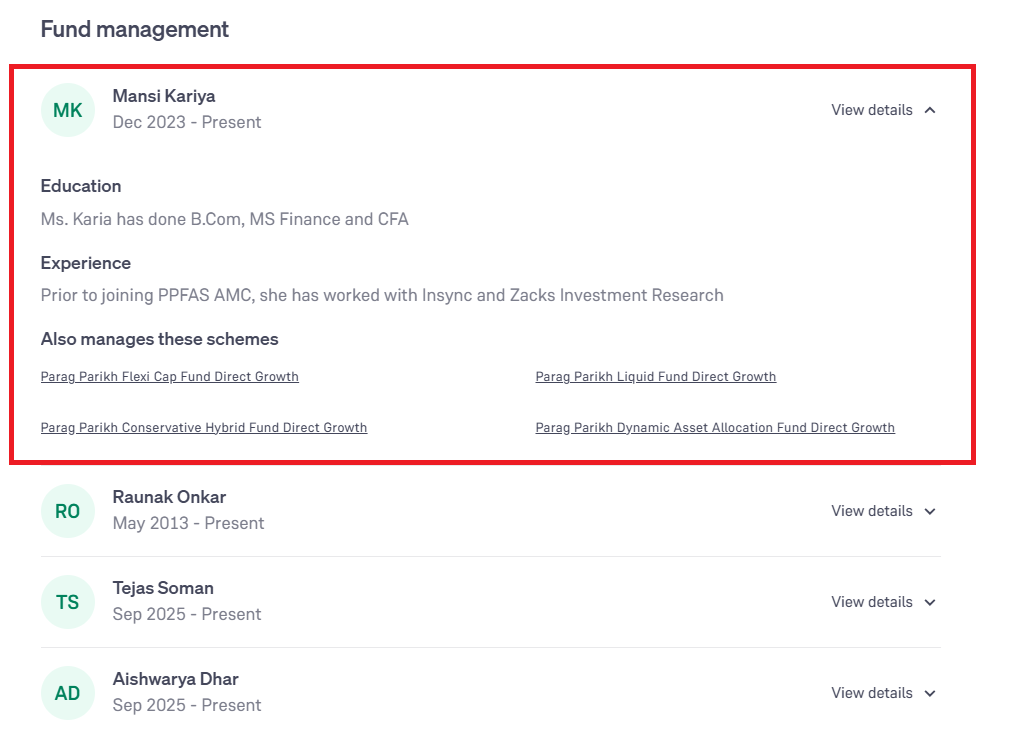
A good fund manager plays an important role in the performance of an actively managed fund.
Instead of looking only at recent performance, check how the fund has performed during different market conditions.
A fund that performs consistently over time is often a better choice than one that performs well only during a strong bull market.
Analyse Consistency Instead of Past Returns
Many beginners make the mistake of choosing the fund that gave the highest return last year.
However, one good year doesn’t guarantee future performance.
Instead, look for funds that have delivered steady performance over several years and across different market cycles.
Consistent performance is usually a better indicator than short-term rankings.
Pro Tip: Don’t compare funds based only on their 1-year returns. Also check their 5-year and 10-year performance on trusted platforms or the AMC’s factsheet. A consistently performing fund is often a better long-term choice than a fund that tops the charts for just one year.
Active vs Passive Equity Funds
When choosing an equity mutual fund, you’ll often come across two categories:
- Active Equity Funds
- Passive Equity Funds (Index Funds)
Let’s understand the difference.
What Are Active Equity Funds?
In an Active Equity Fund, the fund manager actively selects stocks with the aim of generating better returns than a market index, such as the Nifty 50 or Sensex.
The manager regularly buys and sells stocks based on research and market conditions.
Because professional management is involved, active funds generally have a higher expense ratio.
What Are Index Funds?
Index Funds are a type of passive mutual fund.
Instead of trying to beat the market, they simply copy a market index like the Nifty 50 or Sensex.
The fund holds the same stocks in almost the same proportion as the index.
Since there is very little active management, index funds usually have lower expenses.
Key Differences Between Active and Passive Funds
| Feature | Active Equity Fund | Index Fund |
| Fund Management | Managed actively by a fund manager | Tracks a market index automatically |
| Objective | Beat the benchmark | Match the benchmark |
| Expense Ratio | Usually higher | Usually lower |
| Research Required | Managed by experts | No active stock selection |
Which One Should Beginners Choose?
Both options can work well for beginners.
Many new investors start with:
- One Large Cap Active Fund, and
- One Index Fund
This allows them to experience both investment styles while keeping their portfolio simple.
If you’re looking for a low-cost and easy investment option, an Index Fund can be a great starting point. If you prefer professional stock selection and don’t mind paying a slightly higher fee, an Active Equity Fund may suit you better.
How to Start Investing in Equity Funds
Starting your investment journey in equity mutual funds is much easier today than it was a few years ago. Most of the process can be completed online in just a few minutes.
Follow these simple steps to get started:
Complete Your KYC
Before investing in any mutual fund, you must complete your Know Your Customer (KYC) process.
This is a one-time verification required for all mutual fund investors in India.
You’ll usually need:
- PAN Card
- Aadhaar Card
- Mobile Number
- Email ID
- Bank Account Details
Most mutual fund platforms allow you to complete KYC online in around 10–15 minutes.
Choose a Best Mutual Fund Platform
You can invest in equity mutual funds through several trusted platforms, including:
- AMC (Asset Management Company) websites
- CAMS
- KFintech
- SEBI-registered mutual fund apps and investment platforms
Choose a best demat account that is easy to use, transparent about fees, and offers good customer support.
Decide Between SIP and Lump Sum
There are two common ways to invest in equity funds.
Systematic Investment Plan (SIP)
With a SIP, you invest a fixed amount every month.
For example:
- ₹500 per month
- ₹1,000 per month
- ₹5,000 per month
SIPs are ideal for salaried individuals because they encourage regular investing and reduce the need to worry about market timing.
Lump Sum Investment
A lump sum investment means investing a large amount at one time.
This option is generally suitable if:
- You already have a significant amount available to invest.
- You have a long investment horizon.
- You understand the risks of investing during different market conditions.
For most beginners, a SIP is usually the simpler and more disciplined approach.
Select Your First Equity Fund
Avoid the common mistake of investing in too many funds.
Many beginners think that buying five or six equity funds automatically means better diversification.
In reality, many funds hold similar stocks, leading to unnecessary overlap.
Instead, start with one well-chosen equity fund that matches your:
- Financial goals
- Investment horizon
- Risk tolerance
As your knowledge and investment amount grow, you can gradually expand your portfolio if needed.
Monitor and Review Your Investment
Once you’ve started investing, you don’t need to check your portfolio every day.
In fact, checking it too often can lead to emotional decisions.
A good practice is to review your investments once every six months.
During your review, check whether:
- The fund is performing consistently.
- Your financial goals have changed.
- Your SIP amount needs to be increased.
- Your portfolio still matches your risk profile.
Long-term investing rewards patience more than frequent buying and selling.
Taxation of Equity Funds in India
Understanding how equity funds are taxed helps you estimate your actual returns after tax.
The tax you pay depends mainly on how long you stay invested.
Short-Term Capital Gains (STCG) Tax
If you sell your equity fund units within 12 months of buying them, any profit is treated as a Short-Term Capital Gain (STCG).
Long-Term Capital Gains (LTCG) Tax
If you hold your equity fund units for more than 12 months, the profit is treated as a Long-Term Capital Gain (LTCG).
Tax on IDCW (Dividend) Option
If you’ve selected the IDCW (Income Distribution cum Capital Withdrawal) option, any payout you receive is added to your total taxable income.
Read Complete Guide: How mutual funds are taxed in India
Conclusion
Equity funds are not a way to become rich overnight, but they can be a powerful tool for building long-term wealth when used wisely.
If you’re just starting your investment journey, begin with a small SIP in a well-chosen equity fund that matches your financial goals and risk tolerance. Invest regularly, stay patient during market fluctuations, and give your investments enough time to grow.
Remember, successful investing is not about finding the perfect fund or timing the market. It is about staying disciplined, investing consistently, and thinking long term.
Before making any major investment decision, it’s always a good idea to understand the scheme details carefully and, if needed, consult a qualified financial advisor.
Also Read: What is Liquid Funds and how they work.
FAQ’s
Equity mutual funds are regulated by SEBI and managed by professional fund managers.
However, they are market-linked investments, so their value can go up or down. They do not offer guaranteed returns.
Beginners can start with a Large Cap Fund, Flexi Cap Fund, or Index Fund through a small monthly SIP. These funds are generally considered suitable starting points for new investors.
Many mutual funds allow you to start investing with a SIP of ₹500 per month. The minimum lump sum investment varies from one mutual fund to another.
For most salaried investors, a SIP is usually the better option because it encourages disciplined investing and reduces the need to time the market.
Lump sum investing may be suitable if you already have a large amount available and a long-term investment horizon.
Equity funds are generally recommended for at least 5 to 7 years.
A longer investment period gives your portfolio more time to recover from market fluctuations and benefit from compounding.
Since equity funds invest in the stock market, the value of your investment can fall, especially over short periods.
However, long-term investing has historically reduced the impact of temporary market volatility.
For most beginners, 2–3 carefully selected equity funds are usually enough.
Owning too many similar funds often creates overlap rather than improving diversification.
Disclaimer: This article is for informational purposes only and should not be considered tax, legal, or investment advice. Tax laws may change in future budgets. Always verify the latest rules or consult a qualified Chartered Accountant before making investment decisions.