
Have you ever noticed that the things we could buy for ₹500 2-3 years ago we cannot buy for even half that today? This isn’t just your imagination. It’s because of inflation.
Inflation is something that affects everyone. Whether you’re a salaried employee, a student, a business owner, or a retiree, rising prices reduce the value of your money over time.
The good news is that once you understand what causes inflation, you can make smarter financial decisions. You can plan your savings, choose better investments, and protect your money from losing its value.
In this guide, we’ll explain inflation in simple English. You’ll learn what inflation is, what causes it in India, how it affects your daily life, and the practical steps you can take to reduce its impact on your finances.
What Is Inflation?
Inflation explained in simple words.
Inflation means that the prices of goods and services increase over time. As prices go up, the value of your money goes down. In simple words, the same amount of money buys fewer things than it did before.
For example, imagine you bought 1 litre of milk for ₹50 last year. If the price becomes ₹55 this year, that’s inflation. You now have to spend more money to buy the same product. Inflation slowly reduces the purchasing power of your money.
What is inflation rate?
The inflation rate tells us how fast prices are increasing over a certain period, usually one year.
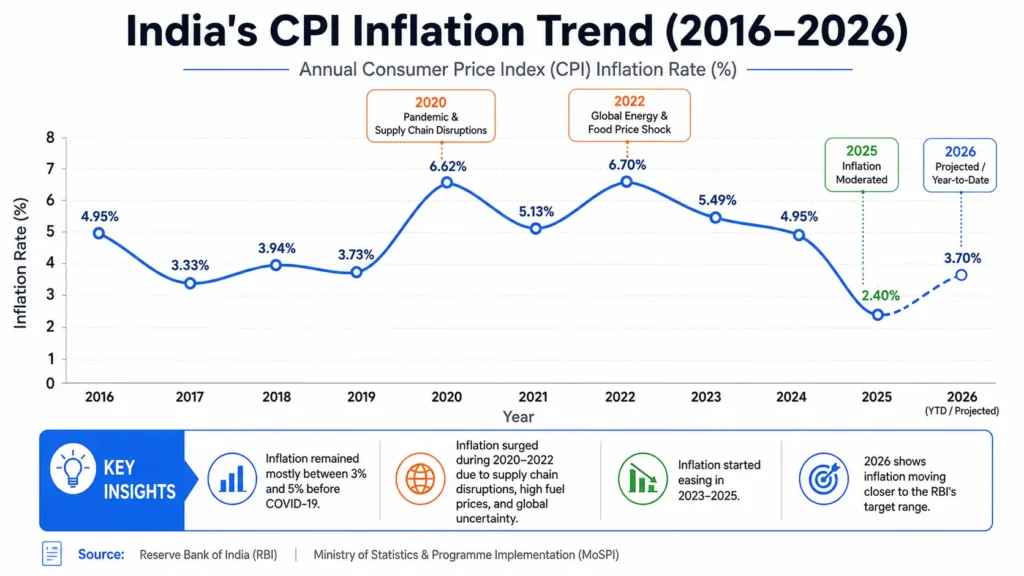
In India, inflation is mainly measured using the Consumer Price Index (CPI). The CPI tracks the prices of everyday items such as food, fuel, clothing, housing, healthcare, and transportation.
For example, if the inflation rate is 6%, a product that cost ₹100 last year will cost about ₹106 this year.
The higher the inflation rate, the faster the cost of living increases.
Inflation vs inflation rate
Many people use these two terms interchangeably, but they have different meanings.
| Aspect | Inflation | Inflation Rate |
| Meaning | The overall increase in prices over time. | The percentage by which prices increase during a specific period. |
| How it’s expressed | A general economic condition or trend. | A number, such as 4%, 5%, or 6%. |
| Example | Grocery prices are increasing every month. | Grocery prices increased by 6% compared to last year. |
| How it’s measured | By observing changes in prices across the economy. | Using indices like the Consumer Price Index (CPI). |
What Is the Main Cause of Inflation in India?
The biggest cause of inflation in India is rising food prices.
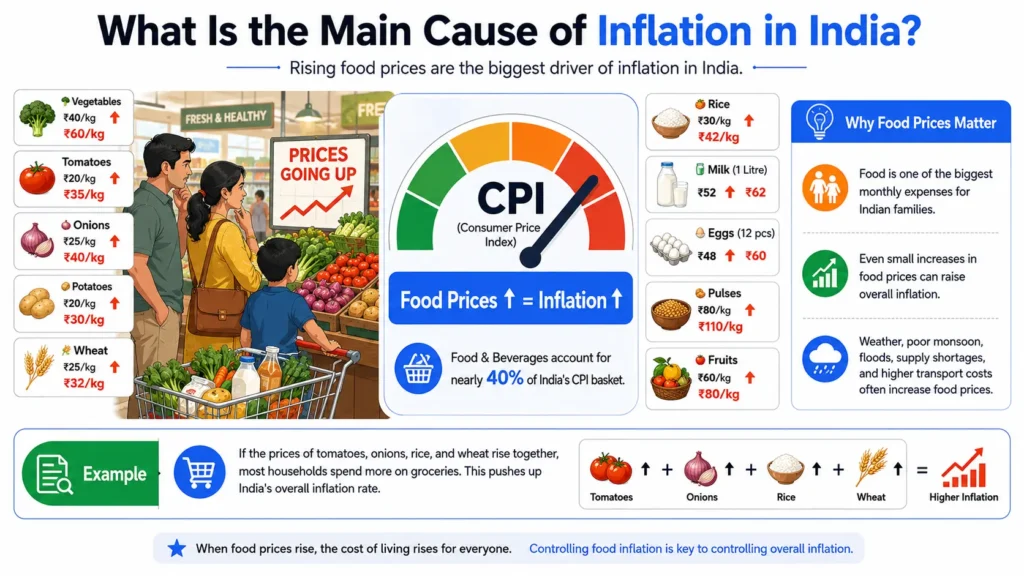
Food is one of the largest monthly expenses for most Indian families. Because of this, even a small increase in the prices of vegetables, fruits, cereals, or pulses can push up the overall inflation rate.
However, food prices are not the only reason. Fuel prices, supply chain disruptions, higher demand, global events, and government policies also play an important role in increasing inflation.
Why food inflation drives India’s prices
Food and beverages make up around 40% of India’s Consumer Price Index (CPI) basket. This means food prices have a big impact on the country’s overall inflation.
For example, if the prices of onions, tomatoes, or wheat increase sharply, millions of households have to spend more on groceries. As a result, the overall inflation rate also rises.
Food prices in India are highly affected by weather conditions. A weak monsoon, floods, heatwaves, or crop diseases can reduce agricultural production. When supply falls, but demand remains the same, prices increase quickly.
This is why food inflation is often the biggest reason behind rising prices in India.
A real-life example of rising food prices
A good example is the tomato price surge in 2023.
Due to heavy rainfall in several states, tomato crops were damaged, and supply dropped sharply. Within a few weeks, tomato prices increased to nearly ₹200 per kg in many cities.
This affected almost everyone.
Families started buying fewer tomatoes, restaurants increased the prices of tomato-based dishes, and food businesses had to bear higher costs.
This is a simple example of how a shortage of one essential food item can increase prices across the economy and contribute to overall inflation.
Other Major Causes of Inflation in India
Rising fuel and transport costs
Fuel prices have a direct impact on the cost of almost everything we buy.
When the prices of petrol and diesel increase, transporting goods becomes more expensive. Whether it’s vegetables, milk, clothes, or electronic items, they all need to be moved from one place to another. Higher transport costs mean businesses spend more to deliver their products.
Instead of bearing these extra costs themselves, most businesses increase the selling price. As a result, consumers end up paying more.
Higher demand than supply
Inflation can also happen when people want to buy more goods than are available in the market.
When demand is higher than supply, sellers often increase prices because they know customers are willing to pay more.
This usually happens during festive seasons in India. During Diwali or the wedding season, the demand for gold, clothes, sweets, electronics, and home appliances increases sharply. If businesses cannot meet this demand quickly, prices tend to rise.
A simple rule is:
- More demand + Less supply = Higher prices
Global events and import costs
India imports crude oil and many other raw materials from different countries. So, events happening anywhere in the world can affect prices in India.
For example, wars, global conflicts, natural disasters, or disruptions in international trade can increase the prices of oil and other essential commodities.
Another important factor is the value of the Indian Rupee. If the rupee becomes weaker against the US dollar, India has to pay more for imports. This increases the cost of fuel, raw materials, and other imported products.
Eventually, businesses pass these higher costs on to customers, leading to higher prices across the economy.

Government taxes and policies
Government policies also a big cause of inflation in India.
For example, taxes such as GST, excise duty on fuel, and import duties affect the final price consumers pay.
If taxes on fuel increase, transportation costs usually rise as well. Since transportation is involved in delivering almost every product, the prices of many goods and services may also increase.
On the other hand, when the government reduces certain taxes or improves the supply of essential goods, inflation may slow down.
In short, government decisions can either increase or help control inflation, depending on the situation.
How Inflation Spreads Across the Economy
From farm to your kitchen
Inflation doesn’t affect just one person or one business. It moves through the entire supply chain before it reaches you.
Let’s understand this with a simple example.
Suppose a farmer grows wheat. Due to poor rainfall, the wheat harvest is lower than expected. Since the supply is less, the price of wheat goes up.
The flour mill now has to buy wheat at a higher price. To cover this extra cost, it increases the price of flour. The bakery then pays more for flour, so it raises the price of bread and biscuits. Finally, when you visit a grocery store, you have to pay more for the same loaf of bread.
This is how inflation spreads from the farm to your kitchen.
How businesses pass on higher costs
Every business has to pay for raw materials, transport, electricity, rent, and employee salaries.
When these costs increase, businesses have two choices:
- Reduce their profits, or
- Increase the price of their products and services.
Most businesses choose the second option because they need to stay profitable.
Why everyday goods become expensive
One increase in cost can affect many other products and services.
For example, when fuel prices rise, transportation becomes more expensive. Since almost every product is transported by road, rail, or air, the cost of delivering goods also increases.
As a result, you may notice higher prices for groceries, medicines, clothes, online deliveries, taxi rides, and even restaurant meals.
This is why inflation is often called a chain reaction. A price increase in one part of the economy can spread to many other sectors, making everyday life more expensive.
Types of Inflation You Should Know
Understanding the different types of inflation helps you know why prices are rising. While there are many types of inflation, these are the three most common ones you should know.
Demand-pull inflation
Demand-pull inflation happens when people want to buy more goods and services than businesses can supply.
When demand is high, but supply is limited, sellers often increase prices because they know customers are willing to pay more.
A common example is concert or cricket match tickets. When thousands of people want a limited number of tickets, ticket prices rise quickly.
In simple words:
Higher demand + Limited supply = Higher prices
Cost-push inflation
Cost-push inflation happens when the cost of making or delivering products increases.
Businesses have to pay for raw materials, fuel, electricity, transportation, and employee salaries. If these costs go up, businesses usually increase the prices of their products to maintain their profits.
Like, if the prices of steel or cement increase, builders may raise the prices of houses and apartments.
This is known as cost-push inflation because rising costs push prices higher.
Built-in inflation
Built-in inflation is also called the wage-price cycle.
It starts when the cost of living increases due to inflation. To manage their higher expenses, employees ask for salary hikes.
When companies increase salaries, their overall costs also increase. To cover these higher costs, many businesses raise the prices of their products and services. As prices increase again, people once again demand higher salaries.
This creates a continuous cycle:
Higher prices → Higher salaries → Higher business costs → Higher prices
If this cycle continues for a long time, inflation can remain high even without any major external reason.
How Inflation Affects Salaried Professionals
For salaried professionals, inflation is more than just an economic term. It directly affects your monthly budget, savings, and long-term financial goals.
Let’s see how.
Your salary buys less every year.
Getting a salary hike every year feels good. But the important question is:
Is your salary growing faster than inflation?
For example, suppose your annual salary increases by 5%, but inflation is 6%. On paper, you’re earning more money. In reality, your purchasing power has gone down because the prices of goods and services have increased faster than your income.
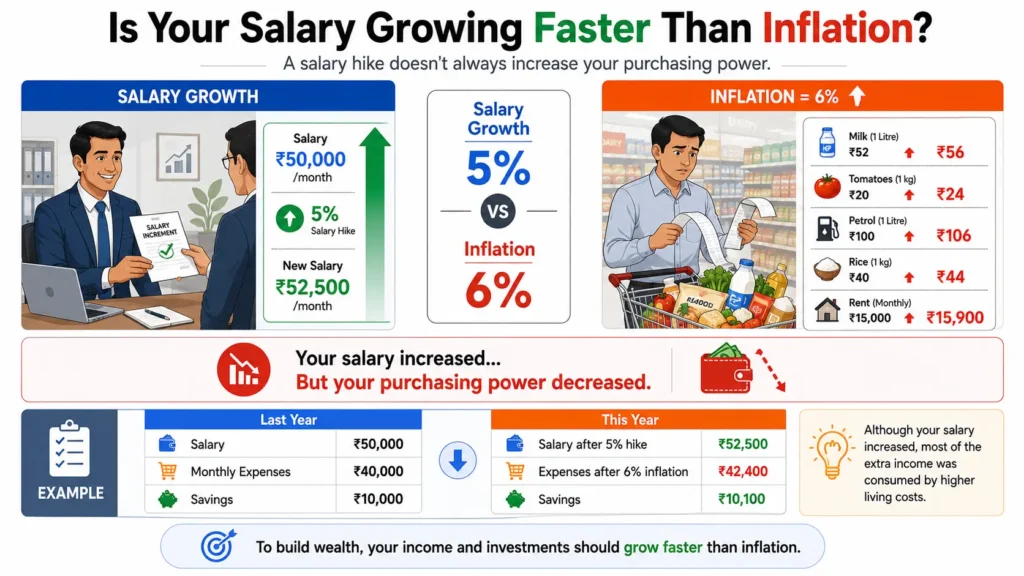
This means your salary can buy fewer things than it could last year. To stay ahead, your income should ideally grow faster than the inflation rate.
Inflation reduces your savings.
Many people keep most of their money in a savings account because it feels safe.
While your money is secure, its real value keeps falling if inflation is higher than the interest you earn.
For example, imagine you have ₹1,00,000 in a savings account earning 3% annual interest. If inflation is 6%, your money grows to ₹1,03,000, but the prices of goods and services have increased even more.
In simple terms, your money has increased in number, but its purchasing power has actually decreased.
This is why financial experts often say:
Saving money is important, but investing wisely is equally important.
Loans, EMIs, and interest rates
Inflation also affects people who have loans.
When inflation remains high, the Reserve Bank of India (RBI) may increase the repo rate to control rising prices. Banks often respond by increasing interest rates on loans.
As a result, borrowers may have to pay:
- Higher home loan EMIs
- Higher car loan EMIs
- More interest on personal loans
This increases your monthly expenses and leaves less money for saving or investing.
Impact on long-term financial goals
Inflation can quietly affect your future financial plans.
Goals like buying a house, funding your child’s education, or planning for retirement become more expensive every year.
For example, if your child’s college education costs ₹20 lakh today, it could cost ₹35–40 lakh or even more after 15 years if education costs continue to rise.
If your investments don’t grow faster than inflation, you may fall short of the amount you need to achieve your goals.
That’s why it’s important to review your financial plan regularly and choose investments that have the potential to beat inflation over the long term.
How to Protect Your Money From Inflation
Inflation is a part of every economy, and you can’t stop it. But you can take smart financial steps to reduce its impact on your money.
Here are some practical ways to stay ahead of inflation.
Invest instead of only saving.
Saving money is important, but saving alone is usually not enough to build wealth over the long term.
If your money stays only in a savings account, it may not grow fast enough to keep up with inflation. Over time, your purchasing power can decrease.
This is why investing is important. Investments give your money the opportunity to grow and help you achieve long-term financial goals.
A good approach is to keep enough money aside for emergencies and invest the rest based on your goals and risk tolerance.
Choose investments that beat inflation.
Not all investments provide the same returns.
Historically, investments such as equity mutual funds, index funds, and equities have delivered better long-term returns than traditional savings accounts. However, market-linked investments can go up and down, so returns are never guaranteed.
You can also consider building a diversified portfolio that includes different asset classes, such as equity and debt, based on your financial goals and risk appetite.
The objective is simple: your investments should have the potential to grow faster than inflation over the long term.
Increase your earning potential.
Cutting expenses has a limit, but increasing your income has much greater potential.
You can improve your earnings by:
- Learning new skills
- Switching to a better-paying job
- Asking for a salary hike based on your performance
- Starting a freelance business or side hustle
- Building an additional source of income
If your income grows faster than inflation, it becomes easier to manage rising living costs and build wealth.
Review your financial plan regularly.
Your financial plan should change as your life changes.
Your income, expenses, family responsibilities, and financial goals may be very different today compared to five years ago.
Review your budget, investments, insurance, and financial goals at least once a year. This helps you make necessary changes and ensures you’re on track to achieve your long-term objectives.
Regular reviews also help you identify investments that are not performing well and rebalance your portfolio when needed.
Common Myths & Facts About Inflation
Many people have misconceptions about inflation. Let’s clear up some of the most common myths.
| Myth | Fact |
| Inflation means the price of every product increases equally. | Not true. Some prices rise much faster than others. For example, food and fuel prices may increase sharply, while the prices of electronics or clothing may remain stable or even fall. |
| Inflation is always bad for the economy. | Not necessarily. Moderate inflation (around 2%–6%) is generally considered healthy because it encourages spending, investment, and economic growth. Very high inflation, however, can hurt consumers and businesses. |
| Only the RBI controls inflation. | The RBI plays an important role by changing interest rates, but it cannot control inflation alone. Government policies, global oil prices, weather conditions, supply chain disruptions, and consumer demand also influence inflation. |
Conclusion
Inflation is a normal part of a growing economy, and it isn’t going away. The good news is that with smart financial planning, disciplined investing, and regular reviews, you can reduce its impact and build long-term wealth.
If you’re unsure which investments are suitable for your goals or risk profile, consider speaking with a SEBI-registered investment adviser or a qualified financial professional before making investment decisions.
FAQ’s
The biggest cause of inflation in India is rising food prices.
The inflation rate is the percentage by which the prices of goods and services increase over a specific period, usually one year.
Food inflation is often high because agricultural production depends heavily on factors such as the monsoon, weather conditions, crop diseases, and transportation.
Inflation reduces the real value of your salary. Even after getting a salary hike, you may be able to buy fewer goods and services if prices rise faster than your income.
The Reserve Bank of India (RBI) mainly controls inflation through monetary policy. One of its key tools is the repo rate.
DISCLAIMER: Please note that the information shared in this blog is for educational purposes only. It should not be considered financial, legal, tax, accounting, or investment advice. Always do your own research or consult a qualified financial advisor before making any financial decisions.