


How mutual funds are taxed in India?
Here’s the quick answer: the tax you pay depends on two things—the type of mutual fund you invest in (equity, debt, or hybrid) and how long you hold it. Equity funds held for more than 12 months are taxed at 12.5% on gains above ₹1.25 lakh in a financial year. Debt funds purchased after 1 April 2023 are taxed according to your income tax slab, no matter how long you hold them.
The tax rules have changed after Budget 2024 and the April 2025 TDS update. This guide explains the latest rules in simple language with practical examples so you can understand exactly how mutual funds are taxed in India.
Quick Summary
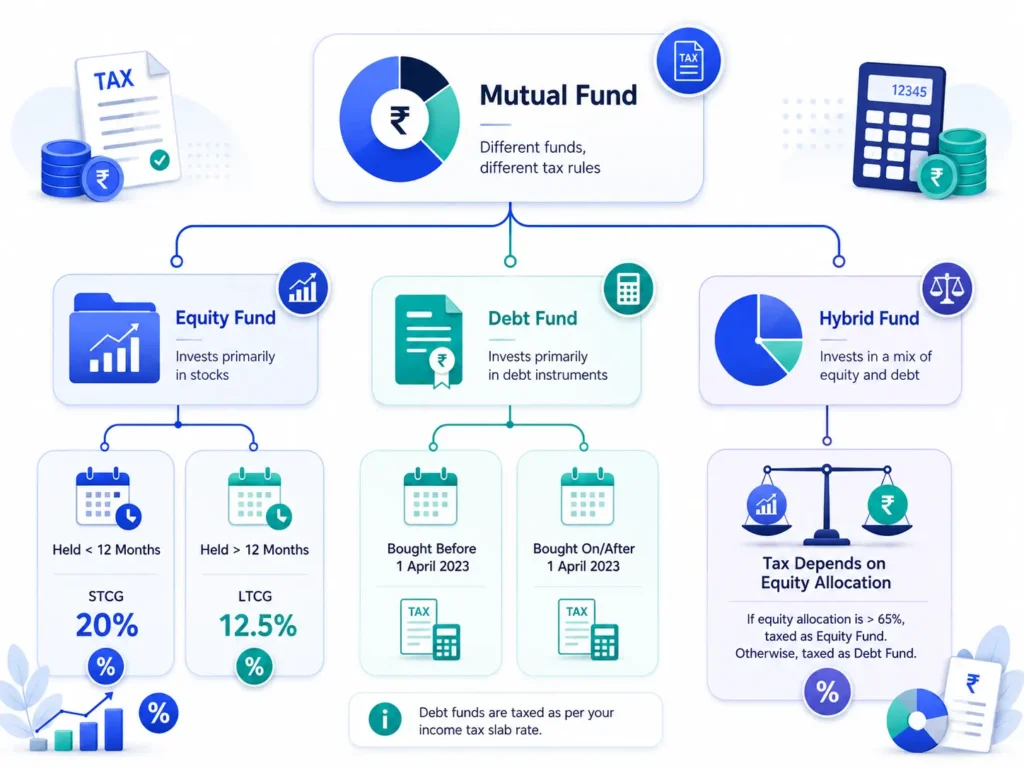
- Equity funds held for less than 12 months: 20% STCG tax
- Equity funds held for more than 12 months: 12.5% LTCG tax on gains above ₹1.25 lakh in a financial year
- Debt funds bought on or after 1 April 2023: Taxed according to your income tax slab, regardless of holding period
- Debt funds bought before 1 April 2023: If held for more than 24 months, they are generally taxed at 12.5% without indexation. In some cases, investors can also compare it with 20% tax with indexation and choose whichever is lower.
- Dividends (IDCW): Added to your total income and taxed according to your income tax slab. TDS applies if dividend income from one AMC exceeds ₹10,000 in a financial year.
- ELSS funds offer a deduction of up to ₹1.5 lakh under Section 80C, but only if you use the old tax regime.
When Do You Actually Pay Tax on Mutual Funds?
Many people think they have to pay tax whenever the value of their mutual fund increases. That is not true.
You pay tax only when you sell, redeem, or switch your mutual fund units. This is called a realised capital gain.
As long as you keep your investment in the mutual fund, you don’t have to pay any tax, even if its value has increased significantly.
Types of Taxes Applicable on Mutual Funds
Three different taxes may apply to mutual fund investments. Many investors confuse these taxes, so it’s important to understand the difference.
Capital Gains Tax
Capital gains tax is charged when you sell or redeem your mutual fund units at a profit.
Depending on how long you held the investment, your gain is classified as either:
- Short-Term Capital Gain (STCG)
- Long-Term Capital Gain (LTCG)
Securities Transaction Tax (STT)
STT is a small tax that is automatically charged when you buy or sell equity mutual fund units.
You don’t need to calculate or pay it separately because it is automatically deducted during the transaction.
Dividend (IDCW) Tax
If you choose the IDCW (Dividend) option instead of the Growth option, any dividend you receive is added to your total income and taxed according to your income tax slab.
Equity vs Debt vs Hybrid Funds — Tax Rate at a Glance
| Fund Type | Holding Period for LTCG | STCG Tax | LTCG Tax | Exemption |
|---|---|---|---|---|
| Equity Funds (65% or more equity) | More than 12 months | 20% | 12.5% | ₹1.25 lakh/year |
| Debt Funds (Bought after 1 April 2023) | No LTCG benefit | Slab Rate | Slab Rate | None |
| Debt Funds (Bought before 1 April 2023) | More than 24 months | Slab Rate | 12.5% (No Indexation) | None |
| Equity-Oriented Hybrid Funds | More than 12 months | 20% | 12.5% | ₹1.25 lakh/year |
| Debt-Oriented Hybrid Funds | No LTCG benefit | Slab Rate | Slab Rate | None |
| International & Gold Funds | More than 12 months | Slab Rate | 12.5% | None |
What Changed After Budget 2024 (23 July 2024)?
Budget 2024 made three major changes to mutual fund taxation.
- Equity STCG increased from 15% to 20%
- Equity LTCG increased from 10% to 12.5%
- Annual LTCG exemption increased from ₹1 lakh to ₹1.25 lakh
Another important change came in April 2025, when the TDS threshold on mutual fund dividends increased from ₹5,000 to ₹10,000.
If you redeemed your investment before 23 July 2024, the old tax rates apply. Redemptions made after that date follow the new tax rules.
How Are Equity Mutual Funds Taxed in India?
Equity mutual funds invest at least 65% of their money in Indian company shares. Their tax treatment depends mainly on one thing—how long you hold your investment.
If you sell before completing 12 months, you pay short-term capital gains tax.
If you sell after 12 months, you pay long-term capital gains tax, which is usually lower.
Short-Term Capital Gains (STCG) on Equity Funds
If you sell your equity mutual fund within 12 months, the profit is taxed at a flat 20%.
This rule applies to:
- Equity mutual funds
- Index funds
- ELSS funds (after lock-in)
- Equity-oriented hybrid funds
There is no exemption for short-term gains. Even a small profit is taxable.
Long-Term Capital Gains (LTCG) on Equity Funds
If you hold your investment for more than 12 months, your profit becomes a long-term capital gain.
The first ₹1.25 lakh of LTCG in a financial year is tax-free. Any gain above this limit is taxed at 12.5%. Indexation benefit is not available.
Worked Example — Calculating Tax on Equity Mutual Fund Gains
Suppose you invest ₹5 lakh in an equity mutual fund.
After 14 months, you sell it for ₹6.5 lakh.
Your total profit is ₹1.5 lakh.
Since you held the investment for more than one year, this is treated as Long-Term Capital Gain (LTCG).
- Total Gain = ₹1,50,000
- Less LTCG Exemption = ₹1,25,000
- Taxable Gain = ₹25,000
Tax = 12.5% of ₹25,000 = ₹3,125 (plus applicable cess).
This is one of the reasons why equity mutual funds are considered tax-efficient for long-term investing.
How Are Debt Mutual Funds Taxed in India (Post-2023 Rules)
Debt mutual fund taxation changed significantly after 1 April 2023. Unlike equity funds, the tax treatment of debt funds now depends mainly on when you purchased the units.
Many investors assume all debt funds get long-term tax benefits, but that’s no longer true.
Debt Funds Bought After 1 April 2023 (Slab Rate Rule)
If you purchased debt mutual fund units on or after 1 April 2023, your profit is always taxed according to your income tax slab.
It doesn’t matter whether you hold the investment for:
- 1 year
- 3 years
- 10 years
There is no long-term capital gains benefit for these investments.
For tax purposes, the profit is treated much like the interest earned on a Fixed Deposit (FD).

Debt Funds Bought Before 1 April 2023 (Grandfathered Rules)
If you bought debt fund units before 1 April 2023 and held them for more than 24 months, different tax rules apply.
Generally, these gains are taxed at 12.5% without indexation.
However, there is an important point many investors miss.
For units sold on or after 23 July 2024, you may compare:
- 12.5% tax without indexation
- 20% tax with indexation
You can choose the option that results in lower tax, if applicable.
This comparison can help investors with older investments reduce their tax liability.
Worked Example — Tax on Debt Mutual Fund Redemption
Let’s understand this with an example.
Example 1: Ramesh
- Invested: ₹3 lakh (January 2022)
- Redeemed: March 2026
- Sale Value: ₹4.2 lakh
- Total Gain: ₹1.2 lakh
Since he purchased the units before April 2023 and held them for more than 24 months:
Without Indexation
- Taxable Gain = ₹1.2 lakh
- Tax = 12.5%
- Total Tax = ₹15,000
With Indexation
Suppose indexation reduces the taxable gain to ₹90,000.
- Tax = 20% of ₹90,000
- Total Tax = ₹18,000
In this case, paying 12.5% without indexation is the better option.
Example 2: Priya
Priya bought the same debt fund in June 2023 and also earned a profit of ₹1.2 lakh. Since she purchased the investment after 1 April 2023, there is no LTCG benefit.
If she falls under the 30% income tax slab, her tax will be: ₹1,20,000 × 30% = ₹36,000
Although both investors earned the same profit, their tax is different because they bought the fund on different dates.
How Are Hybrid and Other Mutual Funds Taxed in India
Hybrid mutual funds do not have separate tax rules. Their taxation depends on whether the fund is treated as an equity fund or a debt fund based on its equity allocation.
Equity-Oriented Hybrid Funds (65% or More Equity)
Hybrid funds with 65% or more of their equity investments are taxed exactly like equity mutual funds.
Examples include:
- Aggressive Hybrid Funds
- Balanced Advantage Funds
- Arbitrage Funds
Tax Rates:
- STCG: 20%
- LTCG: 12.5% after the ₹1.25 lakh annual exemption

Debt-Oriented Hybrid Funds (Less Than 65% Equity)
If the fund invests less than 65% in equity, it is treated as a debt fund for tax purposes.
This means:
- Gains are taxed according to your income tax slab.
- Long-term capital gains benefits are generally not available for investments made after April 2023.
International and Global Mutual Funds Taxation
Many investors think international mutual funds are taxed like equity funds because they invest in company shares.
That is not correct.
International funds, US stock funds, and global index funds are generally treated as non-equity funds under Indian tax laws.
Their taxation is:
- Sold within 12 months: Taxed at your income tax slab.
- Held for more than 12 months: Generally taxed at 12.5% without indexation.
This surprises many investors at the time of redemption.
Tax on Mutual Fund Dividends and SIP Investments
Whether you invest through a lump sum or a Systematic Investment Plan (SIP), the tax rules at the time of redemption remain the same.
However, there are a few important points every investor should know.
How Dividend Income From Mutual Funds Is Taxed in India
If you choose the IDCW (Income Distribution cum Capital Withdrawal) option, any dividend you receive is added to your total taxable income.
It is taxed according to your income tax slab.
The fund house deducts 10% TDS if your total IDCW income from one AMC exceeds ₹10,000 in a financial year.
Remember, TDS is not the final tax.
When you file your Income Tax Return (ITR), your actual tax liability is calculated, and you either pay the balance or claim a refund if excess TDS was deducted.
Is SIP Investment Taxed Differently From Lump Sum?
No.
Investing through SIP is not taxable. You are simply purchasing mutual fund units every month. Tax is charged only when you redeem the units.
Each SIP instalment is treated as a separate investment, and each one has its own purchase date and holding period.
FIFO Rule — How Tax Is Calculated on Partial SIP Redemption
India follows the FIFO (First In, First Out) rule for SIP withdrawals.
This means the oldest units are considered sold first.
For example:
Suppose you started a SIP in January 2024.
If you redeem some units in March 2026, then:
- The units purchased in January and February 2024 have completed more than 12 months and qualify for LTCG.
- Units purchased later may still fall under STCG, depending on their purchase dates.
That’s why every SIP instalment has to be tracked separately while calculating tax.
How to Calculate Tax on Mutual Funds — Step-by-Step Method
Calculating mutual fund tax becomes much easier if you follow these simple steps.
Step 1 — Identify the Fund Type and Holding Period
First, check:
- Is the fund Equity, Debt, or Hybrid?
- When did you buy it?
- When did you sell it?
These details decide which tax rules apply.
Step 2 — Find the Applicable Tax Rate
Next, check:
- Whether the gain is Short-Term or Long-Term.
- Whether you are eligible for the ₹1.25 lakh LTCG exemption.
Then apply the correct tax rate.
Step 3 — Use a Mutual Fund Tax Calculator
If you have multiple SIP investments or many transactions, calculating tax manually can become difficult.
A mutual fund tax calculator or your fund house’s capital gains statement can automatically calculate:
- FIFO
- STCG
- LTCG
- Total taxable gain
This helps reduce mistakes while filing your Income Tax Return.
How to Save Tax on Mutual Funds Legally
Paying tax on mutual fund gains is normal, but there are legal ways to reduce your tax burden. Here are some of the most effective strategies.
Invest in ELSS Funds for Section 80C Benefit.
ELSS (Equity Linked Savings Scheme) is the only type of mutual fund that offers a tax deduction under Section 80C.
You can claim a deduction of up to ₹1.5 lakh in a financial year.
Some key points to remember:
- ELSS has a 3-year lock-in period.
- It has the shortest lock-in among all Section 80C investment options.
- The tax deduction is available only under the old tax regime.
- Under the new tax regime, ELSS still works like an equity mutual fund, but you cannot claim the Section 80C deduction.
Use the ₹1.25 Lakh LTCG Exemption Through Tax Harvesting.
Tax harvesting is a simple strategy that many investors overlook.
Here’s how it works:
If your long-term capital gains from equity mutual funds are close to ₹1.25 lakh in a financial year, you can:
- Redeem units worth gains up to ₹1.25 lakh.
- Pay zero LTCG tax because the gains are within the exemption limit.
- Reinvest the money immediately.
This increases your purchase price (cost of acquisition) and can reduce your future tax liability.
For long-term investors, this strategy can save a significant amount of tax over the years.
Time Your Redemptions Across Financial Years
If you’re planning to redeem a large investment, don’t always withdraw everything at once.
Instead, consider splitting your redemption across two financial years.
For example:
- Redeem part of the investment in March.
- Redeem the remaining amount in April.
This allows you to use the ₹1.25 lakh LTCG exemption in two different financial years instead of just one, which can lower your overall tax bill.
Capital Loss Set-Off Rules on Mutual Funds
If you make a loss on a mutual fund investment, the Income Tax Act allows you to adjust that loss against certain capital gains.
Understanding these rules can help reduce your overall tax liability.
Can You Set Off Short-Term Capital Loss Against Long-Term Gains?
Yes.
A Short-Term Capital Loss (STCL) can be adjusted against:
- Short-Term Capital Gains (STCG)
- Long-Term Capital Gains (LTCG)
This gives investors more flexibility while calculating taxes.
Can Equity Loss Be Adjusted Against Debt Fund Gains?
Many investors believe that all capital losses can be adjusted against any capital gain.
That’s not entirely correct.
In general:
- Capital losses can be adjusted against capital gains based on the STCL and LTCL rules.
- If you’re unsure whether a particular adjustment is allowed, it’s best to consult a tax professional before filing your return.
How Long Can Capital Losses Be Carried Forward?
If you cannot use your capital loss in the current year, you can carry it forward for up to 8 assessment years.
However, there is one important condition:
You must file your Income Tax Return before the due date. If you miss the filing deadline, you lose the right to carry forward the loss, even if the loss is genuine.
How Mutual Fund Taxation Works for NRIs
NRIs (Non-Resident Indians) have different tax rules compared to resident investors. The biggest difference is that Tax Deducted at Source (TDS) is usually deducted at the time of redemption itself.
TDS Rules on Mutual Fund Redemption for NRIs
Unlike resident investors, NRIs are subject to TDS when they redeem mutual fund units.
For equity mutual funds:
- Equity STCG: 20% TDS
- Equity LTCG: 12.5% TDS
For debt mutual funds, TDS depends on the applicable tax rules under Section 50AA.
Also, NRIs do not get the ₹10,000 dividend TDS threshold available to resident investors. TDS can apply from the first rupee of dividend income.
Tax Treaty Benefits and Tax Residency Certificate (TRC)
If India has a Double Taxation Avoidance Agreement (DTAA) with the country where the NRI lives, they may be eligible for a lower TDS rate.
To claim this benefit, the investor generally needs to submit:
- A Tax Residency Certificate (TRC)
- A self-declaration to the mutual fund company before redemption.
How NRIs Can Claim a Refund of Excess TDS
Sometimes, the TDS deducted is higher than the actual tax payable. In that case, the NRI can claim a refund by filing an Income Tax Return (ITR) in India. Many NRIs skip this step and end up paying more tax than required.
How to Report Mutual Fund Income in Your ITR
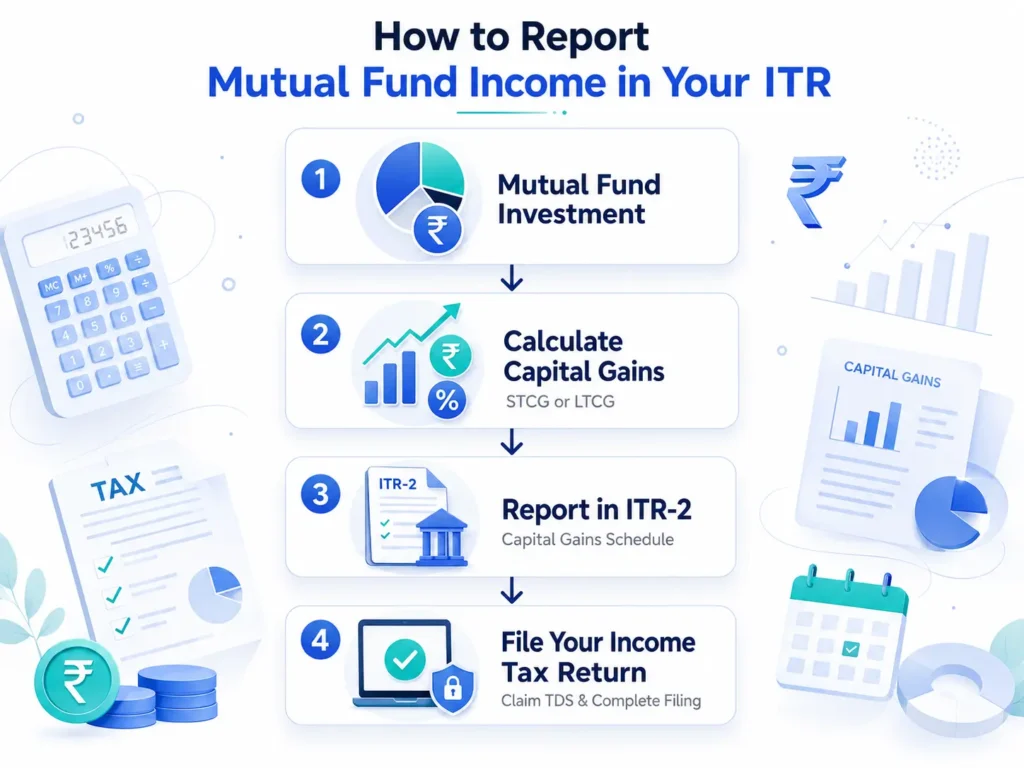
If you’ve earned income from mutual funds, you must report it correctly while filing your Income Tax Return. Using the wrong ITR form or missing important details can create unnecessary problems.
Which ITR Form Should You Use?
If you have capital gains from mutual funds:
- ITR-1 cannot be used.
- Most salaried individuals should use ITR-2.
- If you also have business or professional income, you may need ITR-3.
Where to Report Capital Gains and Dividend Income
While filing your return:
- Report capital gains under the Capital Gains section.
- Report IDCW (Dividend) income under Income from Other Sources.
- Claim credit for any TDS deducted by checking Form 26AS.
Common Mistakes to Avoid While Filing
Avoid these common mistakes:
- Forgetting to report LTCG that falls within the ₹1.25 lakh exemption limit.
- Choosing the wrong ITR form.
- Not checking Form 26AS before claiming TDS credit.
- Missing the ITR filing deadline if you want to carry forward capital losses.
Mutual Fund Taxation vs Other Investments — Which Is More Tax-Efficient?
Different investment options are taxed differently. Here’s a simple comparison to help you understand which investments are more tax-efficient.
| Investment | Tax on Returns | Lock-in Period | Best For |
|---|---|---|---|
| Equity Mutual Funds | 12.5% LTCG on gains above ₹1.25 lakh (held over 12 months) | No lock-in (except ELSS: 3 years) | Long-term wealth creation |
| Fixed Deposits (FDs) | Interest taxed as per your income tax slab every year | No lock-in (regular FD) | Safe investment |
| Public Provident Fund (PPF) | Completely tax-free | 15 years | Long-term, risk-free savings |
| Direct Stocks | Same tax rules as equity mutual funds | No lock-in | Investors who prefer managing their own portfolio |
| Debt Mutual Funds (Post-April 2023) | Taxed according to your income tax slab | No lock-in | Short-term investments and parking surplus funds |
Among these options, PPF offers the biggest tax advantage because both the interest earned and the maturity amount are tax-free.
However, your money stays locked in for 15 years.
On the other hand, equity mutual funds and direct stocks follow the same tax rules, but mutual funds offer better diversification and require less effort to manage.
Pro Tip
Before redeeming your mutual fund investment, download your Capital Gains Statement from your fund house or platforms like CAMS or KFintech.
These statements automatically calculate:
- FIFO
- Short-Term Capital Gains
- Long-Term Capital Gains
This saves time and reduces errors, especially if you’ve been investing through SIPs for several years.
Conclusion
Mutual fund taxation may seem confusing at first, but it becomes much easier once you understand two things:
- What type of mutual fund you own
- How long you’ve held the investment
These two factors determine almost every tax rule discussed in this guide.
Before redeeming your investment, calculate your expected tax using a reliable mutual fund tax calculator or your capital gains statement. If your investments involve multiple fund types, NRI taxation, or large amounts, it’s a good idea to consult a qualified tax professional for personalised advice.
FAQ’s
No. You pay tax only when you redeem or switch your mutual fund units.
No. Gains are not taxed until they are realised by selling or redeeming the units.
No. Both follow the same tax rules. Each SIP instalment simply has its own purchase date and holding period.
Yes. Dividends (IDCW) are added to your income and taxed according to your income tax slab.
Yes. A switch is treated as selling one mutual fund and buying another, so it is considered a taxable transaction.
Generally, equity mutual funds held for more than 12 months are among the most tax-efficient because they enjoy a 12.5% LTCG rate and the ₹1.25 lakh annual exemption.
You can reduce your tax by:
- Investing in ELSS (under the old tax regime)
- Using the annual LTCG exemption through tax harvesting
- Spreading large redemptions across different financial years
No, ELSS gives you a tax deduction under Section 80C, but the gains after the 3-year lock-in are still taxed like other equity mutual funds.
Yes, NRIs pay tax on mutual fund investments, and TDS is generally deducted at the time of redemption.
- For residents, TDS applies on IDCW (dividend) income above ₹10,000 from one AMC in a financial year.
- For NRIs, TDS applies on capital gains at redemption.
FIFO (First In, First Out) means the oldest units are considered sold first when you make a partial redemption.
Exit load is a fee charged by the mutual fund company. It is different from income tax.
Disclaimer: This article is for informational purposes only and should not be considered tax, legal, or investment advice. Tax laws may change in future budgets. Always verify the latest rules or consult a qualified Chartered Accountant before making investment decisions.