
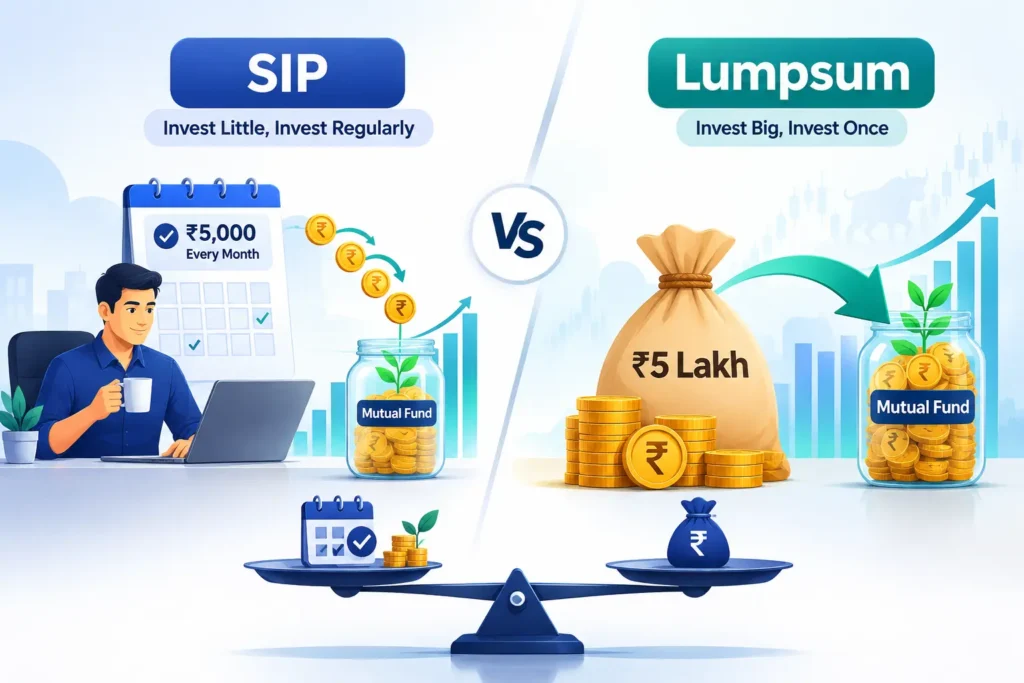

SIP vs Lumpsum which is better: Neither SIP nor lump sum is always better. SIP can be a good choice if you earn regularly and want to invest small amounts over time. A lump sum can be better if you already have a large amount of money and are comfortable investing it at once. The right choice depends on your investment time horizon, risk tolerance, available funds, and market conditions.
In this article, we will compare SIP vs lumpsum investments using simple examples and real-life situations. By the end, you will have a better idea of which approach may suit you.
Key Takeaways
- SIP means investing a fixed amount regularly, usually every month. It is suitable for people with a regular income.
- Lumpsum means investing a large amount in one go. It can be suitable when you already have surplus money and a long investment horizon.
- Neither SIP nor lumpsum guarantees better returns.
- SIP reduces timing risk, but it does not remove market risk.
- For many investors, using both can make sense: SIP for monthly salary savings and lumpsum for bonuses or other extra money.
What Are SIP vs Lumpsum Investments?
A SIP, or Systematic Investment Plan, means investing a fixed amount in a mutual fund at regular intervals, usually every month.
A lumpsum investment means investing the entire amount in a mutual fund in one transaction.
Both methods can be used to invest in the same mutual funds. The main difference is when and how your money enters the market.
How Does a SIP Work?
Think of a SIP like a recurring investment. The difference is that instead of earning fixed interest, your money is used to buy mutual fund units.
For example, suppose you start a SIP of ₹5,000 every month. The amount is automatically deducted from your bank account and invested in the mutual fund you selected.
When the market is down, ₹5,000 can buy more units because prices are lower. When the market is up, the same ₹5,000 buys fewer units.
Over time, this can help average the price at which you buy units. This is called rupee cost averaging.
You do not need to decide every month whether the market is at the perfect level. Your investment happens automatically.
How Does a Lumpsum Investment Work?
A lumpsum investment means investing a large amount at one time.
For example, suppose you have ₹5 lakh and invest the entire amount in a mutual fund on one day. From that day, the whole ₹5 lakh is exposed to market movements.
This makes the timing of your investment more important.
If you invest just before the market falls, the entire amount can fall in value. But if you invest before the market rises, your entire investment benefits from that rise.
There is no gradual investing here. Your full amount enters the market at once.
How Are They Different?
The main difference between SIP and lumpsum is when your money enters the market.
| Factor | SIP | Lumpsum |
| Investment frequency | Regular, usually monthly | One-time |
| Market exposure | Gradual | Immediate and full |
| Timing risk | Lower because investments are spread out | Higher because everything is invested at once |
| Cash requirement | Smaller regular amount | Large amount upfront |
| Best suited for | People with regular income | People with surplus money |
Which Can Give Higher Returns: SIP or Lumpsum?
No method always gives higher returns.
Lumpsum can perform better when the market keeps rising because your entire amount is invested from the beginning. SIP can be useful during volatile or falling markets because you continue investing at different price levels.
The final result depends largely on when your money enters the market and what happens afterward.
How Lumpsum Performs in a Rising Market
When the market rises steadily for several years, lumpsum investing generally has an advantage.
Why?
Because the entire amount is invested from day one. So, the complete amount gets more time to grow and compound.
For example, if you have ₹5 lakh available today and invest the full amount, all ₹5 lakh participates in the market from the beginning.
If you invest the same ₹5 lakh over several months, some of your money stays outside the market during that period.
This is why a lump sum can perform better during a steadily rising market.

How SIP Performs During Market Volatility
The situation changes when markets become volatile or fall.
When the market falls, your regular SIP continues buying mutual fund units at lower prices. This can reduce your average purchase cost over time if the market later recovers.
For example, during the market crash in March 2020, some investors stopped their SIPs because they were afraid of further losses.
Investors who continued their SIPs during the fall were able to buy units at lower prices. When markets recovered, those investments benefited from the recovery.
SIP works best when you continue investing even during market downturns instead of stopping out of fear.
Why Neither Strategy Guarantees Higher Returns
The biggest factor affecting your returns is not simply whether you choose SIP or lumpsum.
What matters is the sequence of market returns after you invest.
Two people can invest the same amount in the same mutual fund and still get different results because their money entered the market at different times.
This is why trying to find a strategy that always gives higher returns is unrealistic.
In the long run, staying invested through different market cycles can matter more than trying to find the perfect investment method.
When Should You Choose SIP?
SIP can work well when your income comes regularly, such as a monthly salary. It also helps if you want a simple investment system that does not require you to make a decision every month.
If You Invest From Your Monthly Salary
Suppose you earn ₹60,000 per month but do not have a large amount available for investment today.
In that situation, a SIP can be practical. You can invest a fixed amount every month instead of waiting until you have a large amount saved.
For example, you could start with a ₹5,000 or ₹10,000 monthly SIP based on your income, expenses, and financial goals.
If You Want to Spread Your Entry Points
Are you worried that the market may be expensive today?
SIP can reduce the need to make that decision.
Instead of investing your entire amount on one date, you invest across different dates and market levels. When prices are lower, you buy more units. When prices are higher, you buy fewer units.
This spreads your investment entry points over time.
If You Prefer Disciplined Investing
SIP is not only a financial strategy. It can also help you build an investing habit.
With an automatic SIP, money is invested regularly without you having to remember it every month.
This can reduce the chances of delaying your investment or stopping it because of short-term market news.
For many beginners, this discipline is one of the biggest benefits of SIP.
When Does Lump sum Make More Sense?
Lump sum can make sense when you already have a large amount of money available and do not need it for a long time.
For example, you may receive a bonus, inheritance, property-sale proceeds, or another large amount.
If You Already Have a Large Corpus
Suppose you receive ₹5 lakh or ₹10 lakh and keep the entire amount in a savings account while waiting for the “right time” to invest.
You may miss out on potential growth during that waiting period.
If the money is genuinely surplus and meant for long-term investment, investing it may make more sense than keeping it idle for years.
However, the investment should still match your financial goals and risk level.
If You Have a Long Investment Horizon
Your investment horizon matters a lot.
Someone investing for retirement 20 years away generally has more time to recover from short-term market falls than someone who needs the money after two years.
A longer investment period gives your investment more time to go through different market cycles.
If You Can Handle Short-Term Market Falls
Be honest with yourself.
Suppose you invest ₹5 lakh today and its value falls to ₹4.3 lakh next month.
Would you stay invested, or would you panic and withdraw?
If you know that a short-term fall would make you sell your investment, lump sum may not be comfortable for you.
Your ability to handle volatility matters just as much as the mathematical calculation.
What If You Have ₹10 Lakh to Invest?
Suppose you already have ₹10 lakh available for investment.
You generally have three options:
- Invest the entire amount at once.
- Invest it gradually over several months.
- Use an STP to gradually move the money into an equity fund.
Investing ₹10 Lakh at Once
You could invest the entire ₹10 lakh in an equity mutual fund on one day.
The biggest advantage is that your complete money is invested from day one.
If the market rises after your investment, the entire ₹10 lakh benefits from that growth.
The disadvantage is that the market could fall soon after you invest.
So, your entry point matters more with lump sum investing.
Investing ₹10 Lakh Gradually
Another option is to divide ₹10 lakh into smaller amounts.
For example, you could invest ₹1 lakh every month for 10 months.
This reduces the risk of putting the entire amount into the market on a single day.
However, there is also a downside.
The money that has not yet been invested remains outside the equity market while you wait for future investment dates.
What About STP?
STP stands for Systematic Transfer Plan.
It can be a middle option for people who have a large amount but are uncomfortable investing everything into equity at once.
For example, you could initially keep ₹10 lakh in a liquid or debt fund and then transfer a fixed amount every month into an equity fund.
This is similar to a SIP, but the money comes from another mutual fund instead of directly from your bank account.
This allows you to gradually move the money into equity instead of investing the entire amount on one day.
Does SIP Really Reduce Investment Risk?
SIP reduces timing risk, but it does not remove market risk.
This difference is important.
SIP Reduces Timing Risk, Not Market Risk
Timing risk means the risk of investing your entire amount at an unfortunate time, such as just before a major market fall. SIP reduces this risk because your money enters the market at different times.
However, once your money is invested, it is still exposed to the market.
SIP does not protect you from losses caused by falling markets.
Your Fund Still Has Market Risk
Suppose you have been investing through SIP for two years and the market falls by 15%.
Your accumulated investment can also fall in value. SIP does not mean that your investment is “safe.” It simply means that your investment is being made gradually.
This is an important difference between reducing timing risk and reducing market risk.
How Risk Tolerance Should Affect Your Choice
Think about how you react to market news.
If seeing a large amount of money move up and down makes you uncomfortable, investing smaller amounts through SIP may feel easier.
If you can handle short-term fluctuations without making emotional decisions, you may be more comfortable with lump sum investing.
What About Taxes and Market Timing?
Mutual fund taxation depends on factors such as how long you hold the investment and the type of mutual fund.
It does not simply depend on whether you used SIP or lumpsum.
However, there is an important difference: each SIP instalment is treated as a separate investment for tax purposes.
How Taxation Works for SIP Investments
Every SIP instalment has its own investment date.
So, when you redeem your mutual fund units, each instalment is considered separately based on how long it has been held.
For example, your first SIP instalment may have been invested several years ago, while your latest instalment may have been invested only recently.
Therefore, the tax treatment can differ between these units depending on the applicable rules.
How Taxation Works for Lumpsum Investments
With a lumpsum investment, the entire amount is invested on one date.
This makes the investment date easier to identify when calculating capital gains.
Whether the gains are treated as short-term or long-term depends on the applicable rules for the type of fund and the holding period.
Read more about: How mutual funds are taxed in India.
Do You Need to Time the Market for a Lump Sum?
Trying to find the perfect time to invest is extremely difficult.
Even professional investors cannot consistently predict the exact market bottom.
Instead of trying to predict the perfect day, investors can focus on their investment horizon, risk level, and whether the investment fits their overall financial plan.
For large investments or specific tax-planning decisions, consulting a SEBI-registered financial advisor can be useful.
Which Investment Approach Is Right for You?
There is no universal winner between SIP and lump sum.
The better option depends on:
- How you receive your income
- How much money you currently have
- How long you can stay invested
- How comfortable you are with market fluctuations
SIP May Be Better If You Have Regular Income
If your income comes every month, such as a salary, SIP naturally fits your cash flow.
You do not need to wait until you have a large amount of money.
You can invest a fixed amount every month and gradually build your investment portfolio.
Lumpsum May Be Better If You Have Surplus Money
If you already have a large amount of money that you do not need for several years, lumpsum investing can put the money to work immediately.
You do not have to keep the money sitting idle while waiting for the “perfect” market entry.
However, you should only invest money that you can afford to keep invested for the required period.
Phased Investing May Suit Some Large-Corpus Investors
If you have a large amount but are uncomfortable investing everything at once, you can consider spreading the investment over 6 to 12 months.
An STP can also be used for this purpose.
This gives you a middle path between investing everything immediately and keeping the entire amount outside the market.
Conclusion
There is no single correct answer to the SIP vs lumpsum question.
The right choice depends on how you earn your money, how long you can stay invested, and how comfortable you are with market ups and downs.
If you earn a regular salary, starting a SIP can be a simple way to invest consistently without needing a large amount upfront.
If you already have a large amount of surplus money, lumpsum investing can put that money to work immediately. Keeping it in a low-interest account while waiting for the “perfect time” may not always be the best approach.
FAQ’s
SIP can suit people with regular income and can reduce timing risk. Lump sum can suit people who already have surplus money and a long investment horizon.
The right choice depends on your income, investment goals, and comfort with market fluctuations.
It depends on what the market does after you invest.
Lump sum can perform better when the market rises steadily because the entire amount is invested from the beginning.
SIP can be helpful during volatile or falling markets because you continue buying units at different prices.
Not, when it comes to overall market risk.
Both SIP and lumpsum investments are exposed to the performance of the mutual fund.
SIP mainly reduces the risk of investing your entire amount at one bad time.
Yes, You can run a monthly SIP from your salary and invest bonuses, tax refunds, or other large amounts through lumpsum or STP.
No fixed amount works for everyone.
Your SIP should fit your income, expenses, financial goals, and emergency fund.
Start with an amount that you can comfortably continue every month. You can increase it as your income grows.
It can be suitable if you have a long investment horizon, such as 5 to 7 years or more, and can handle short-term market falls.
If you may need the money soon, you should be more careful about investing the entire amount in equity.
If you already have a SIP, continuing it during a market crash can allow you to buy more units when prices are lower.
Starting a new lumpsum during a crash can also offer an opportunity to invest at lower prices, but it carries short-term risk because the market can fall further before recovering.
Disclaimer: This article is for educational and informational purposes only. It explains the basic differences between SIP and lumpsum investing and is not a recommendation to buy, sell, or invest in any particular mutual fund or financial product.
Mutual fund investments are subject to market risks, and past performance does not guarantee future returns. The returns and examples mentioned in this article are for understanding purposes only and may differ from actual market performance.
Before investing, consider your financial goals, risk tolerance, investment horizon, and current financial situation. For personalised investment advice, consider consulting a SEBI-registered investment advisor.
Always read the scheme-related documents carefully before investing.