
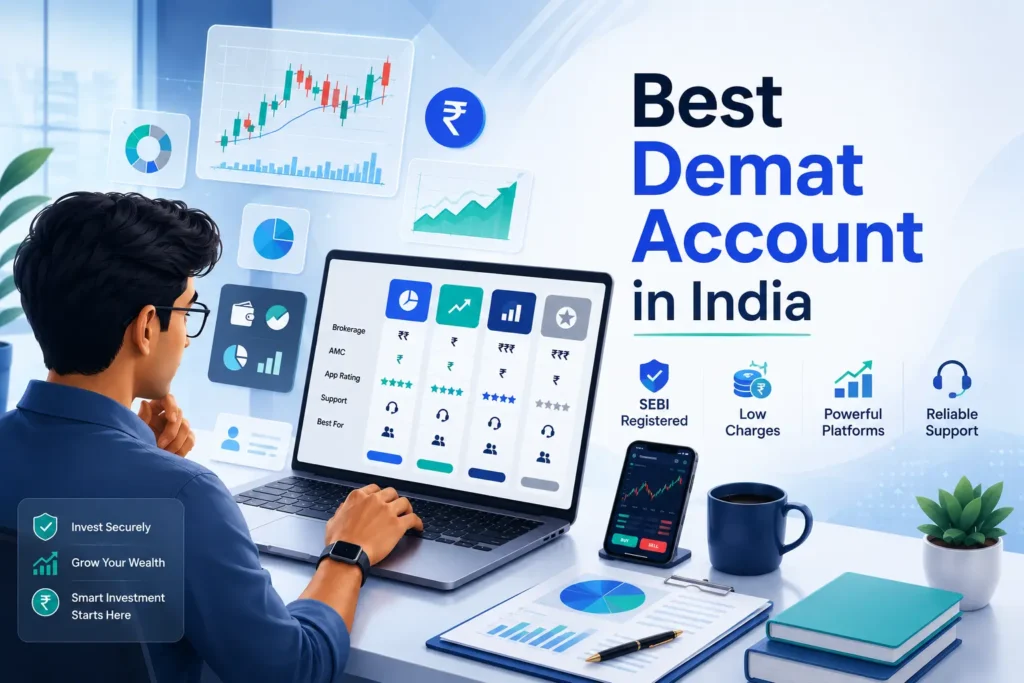

Choosing a best demat account in india looks easy at first. But once you start comparing brokers, you find many options claiming to be the “best.” That can make the decision confusing.
The truth is, there is no single best demat account for everyone. The right choice depends on how you invest. A beginner starting their first SIP has different needs from someone who trades every day. Brokers like Zerodha, Groww, Upstox, and Angel One are among the most popular in India, but each is best suited to a different type of investor.
In this guide, we’ll compare the top demat accounts in India based on important factors like brokerage charges, Annual Maintenance Charges (AMC), hidden fees, app experience, and customer support. This will help you choose a broker that matches your needs instead of simply following someone else’s recommendation.
Key Takeaways
- There is no single best demat account in India for everyone.
- Choose a broker based on your investment style and financial goals.
- Don’t compare only brokerage charges—check AMC, DP charges, and other hidden fees as well.
- Long-term investors should focus on low maintenance costs, while active traders should prioritise low brokerage and fast execution.
- Always verify the latest charges on the broker’s official website before opening an account.
- Open your account only with a SEBI-registered broker to keep your investments safe.
What Is a Demat Account?
A demat account is a digital account that stores your financial investments such as shares, mutual funds, bonds, and ETFs. Earlier, investors received paper share certificates. Today, everything is stored electronically, making investing much safer and easier.
Think of it like this:
- Your bank account stores your money.
- Your demat account stores your investments.
- Your trading account is used to buy and sell those investments.
Today, most stock brokers open both the trading and demat account together, making the process simple.
What makes a demat account “the best”?
There isn’t one demat account that is perfect for everyone. The best one depends on your needs. However, these four factors matter the most.
Security
Security should be your top priority. The good news is that all SEBI-registered brokers store your investments with NSDL or CDSL. Even if a broker stops operating, your shares remain safe.
Low Charges
Small charges can make a big difference over time. For example, paying ₹300 annually as an AMC may not seem like much, but over 15 years, it amounts to ₹4,500 that could have remained invested.
Easy-to-Use App
A simple and user-friendly app makes investing much easier. A confusing platform can lead to mistakes and frustration, especially for beginners.
Customer Support
You may rarely need customer support, but when a payment fails, an IPO application gets stuck, or there’s an issue with your account, good support becomes very important.
How We Compared the Best Demat Accounts in India
We compared brokers based on:
- Account opening charges
- Annual Maintenance Charges (AMC)
- Brokerage for delivery and intraday trading
- Trading platform and mobile app experience
- Research and investing tools
- User reviews and overall reputation
Broker charges may change from time to time, so always check the latest pricing on the broker’s official website before opening an account.

Top 10 Demat Accounts in India Compared
| Broker | Best For | Account Opening | AMC (Per Year) | Brokerage (Delivery / Intraday) | App Rating | Overall Rating |
|---|---|---|---|---|---|---|
| 1. Zerodha | Long-term investors & all-round investing | Free | ₹300 | ₹0 / ₹20 or 0.03% per order | 4.5/5 | 4.5/5 |
| 2. Groww | Beginners & mutual fund investors | Free | ₹0 | ₹20 or 0.1% (whichever is lower) | 4.0/5 | 4.3/5 |
| 3. Angel One | Beginners needing guidance | Free | ₹240 | Up to ₹20 per order | 4.4/5 | 4.4/5 |
| 4. Upstox | Intraday & F&O traders | Free* | ₹300 (often free in Year 1) | ₹0 Delivery / ₹20 Flat | 4.3/5 | 4.3/5 |
| 5. ICICI Direct | Banking & research support | Free | ₹700 (₹300 with iValue) | Around 0.29% / 0.03% | 4.0/5 | 4.0/5 |
| 6. Dhan | Active F&O traders | Free | ₹0 | ₹0 Delivery / Low F&O charges | 4.4/5 | 4.4/5 |
| 7. Motilal Oswal | Research & advisory | Free/Low | Around ₹200–₹400 | Depends on plan | 4.0/5 | 4.0/5 |
| 8. Kotak Neo | Kotak Bank customers | Free | ₹0–₹300 | Depends on plan | 4.0/5 | 4.0/5 |
| 9. Sharekhan | Investor education | Free/Low | Around ₹400+ | Depends on plan | 3.9/5 | 3.9/5 |
| 10. 5paisa | Budget-friendly investing | Free/Low | Under ₹300 | Low flat brokerage | 3.9/5 | 3.9/5 |
Note: Charges for Motilal Oswal, Kotak Neo, Sharekhan, and 5paisa may change depending on the plan you choose. Always verify the latest charges before opening an account.
1. Zerodha
Zerodha is India’s largest stock broker by active users. Its trading platform, Kite, is known for being fast, simple, and reliable. It also offers useful tools like Console for portfolio tracking and Varsity for learning about the stock market.
Although Zerodha charges an AMC of ₹300 per year, many investors find it worth paying because of its excellent platform and features.
2. Groww
Groww started as a mutual fund investment platform and later expanded into stock investing.
Its clean and beginner-friendly interface makes it one of the easiest apps for first-time investors. Since Groww doesn’t charge any AMC, it’s a great choice for long-term investors who want to keep costs low.
3. Angel One
Angel One is a good option for beginners who want investment guidance.
The platform offers stock recommendations, research reports, and educational resources. It also has a strong offline branch network, making it easier for people who prefer speaking with a representative.
4. Upstox
Upstox is popular among active traders because of its flat ₹20 brokerage model and useful trading tools.
It offers fast order execution and advanced charting features, making it suitable for intraday and F&O trading.
5. ICICI Direct
ICICI Direct offers a convenient 3-in-1 account that combines your bank account, trading account, and demat account.
Although its AMC is higher than many discount brokers, it’s a good option for existing ICICI Bank customers who want everything in one place.
6. Dhan
Dhan has become one of the most popular brokers among F&O traders.
It offers advanced charting, API support, zero AMC, and zero brokerage on equity delivery. These features help active traders save money over time.
7. Motilal Oswal
Motilal Oswal is known for its strong research and advisory services.
If you prefer expert recommendations before investing, this broker can be a good choice even though its charges are slightly higher than discount brokers.
8. Kotak Neo
Kotak Neo is a suitable option for people who already have a Kotak Mahindra Bank account. it provides a smooth banking and investing experience under one platform.
9. Sharekhan
Sharekhan has been serving Indian investors for more than two decades.
It is well known for investor education through Sharekhan Classroom and offers a variety of research reports for investors.
10. 5paisa
5paisa is a budget-friendly discount broker designed for beginners and cost-conscious investors.
Its low brokerage charges and affordable plans make it a good choice for people who are just starting their investment journey.
Best Demat Account in India for Different Investment Needs
Choosing the right demat account becomes much easier when you know your investment style. Here are the best options for different types of investors.
Demat Account for Beginners
If you’re investing for the first time, Groww and Zerodha are excellent choices.
Both platforms have easy-to-use apps and a simple account opening process. You don’t need advanced trading tools in the beginning, so focus on a broker that makes investing easy to understand.
Demat Account for Long-Term Investors
If your goal is to invest in stocks for several years, Zerodha is one of the best options.
It charges zero brokerage on equity delivery, so you don’t pay brokerage while buying or selling long-term investments. The yearly AMC is predictable, making it suitable for investors who prefer a buy-and-hold strategy.
Demat Account with Lowest Brokerage
If keeping costs low is your top priority, Groww and Dhan are worth considering.
Both offer zero brokerage on equity delivery, while Dhan also provides competitive charges for F&O trading. Since brokerage plans can change, always check the latest fee structure before opening an account.
Demat Account for Intraday & F&O Trading
Active traders usually place many trades every week. In this case, even small brokerage differences can make a big impact over time.
Zerodha, Upstox, and Dhan are popular because they offer flat and transparent brokerage charges along with reliable trading platforms. Active traders usually place many trades every week. In this case, even small brokerage differences can make a big impact over time.
Demat Account for IPO Investors
If you regularly apply for IPOs, Angel One and Zerodha offer a smooth UPI-based IPO application process.
A stable platform becomes especially important during popular IPOs when thousands of investors are applying at the same time.
Demat Account Charges in India
Many people compare brokers only by brokerage charges. However, that’s only one part of the total cost.
When choosing a demat account, you should understand these three types of charges:
Brokerage Charges
Brokerage is the fee you pay whenever you buy or sell shares.
Most discount brokers charge:
- ₹0 brokerage on equity delivery
- A flat fee or a small percentage for intraday and F&O trades
Annual Maintenance Charges (AMC)
AMC is the yearly fee for maintaining your demat account.
You have to pay this fee even if you don’t trade frequently.
For example:
- Groww: ₹0 AMC
- Dhan: ₹0 AMC
- Zerodha: ₹300 per year
- ICICI Direct: Up to ₹700 per year (depending on the plan)
Hidden Charges You Should Check
Many investors ignore these charges while opening an account.
Before choosing any broker, ask about these fees:
- DP Charges: Charged whenever you sell shares from your demat account.
- Pledge Charges: Applicable if you pledge shares for margin.
- Call & Trade Charges: Extra charges if you place orders over the phone.
- Margin Interest: Interest charged when you trade using borrowed funds.
These charges may seem small, but they can increase your overall investment cost over time.
Pro Tip: Instead of looking only at “Zero Brokerage,” calculate how much you’ll actually pay in a year based on your investing habits.
How to Choose the Best Demat Account in India
Don’t choose a broker just because it’s trending on social media or recommended by a friend.
Choose one that matches the way you invest.
For example, a salaried employee investing through monthly SIPs has very different needs than someone who trades daily.
Here are some simple guidelines:
If You’re a Long-Term Investor
Choose a broker that offers:
- Low or zero delivery brokerage
- Low AMC
- Simple investing experience
If You’re an Active Trader
Focus on:
- Fast order execution
- Stable trading platform
- Low brokerage per trade
- Advanced charts and trading tools
If You’re a Beginner
Your priority should be:
- Easy-to-use mobile app
- Simple account opening process
- Good customer support
- Educational resources
Check App Reviews Before Opening an Account
Don’t rely only on advertisements.
Read recent reviews on Google Play Store or the App Store to see how the app performs during market hours. A slow or crashing app can cause more loss than the brokerage you save.
Verify SEBI Registration
Always open a demat account with a SEBI-registered broker.
Your investments are stored safely with either NSDL or CDSL, which are India’s official depositories for electronic securities. Taking two minutes to verify the broker’s registration can save you from future problems.
Demat Account vs Trading Account: What’s the Difference?
Many beginners think a demat account and a trading account are the same. In reality, they have different purposes.
What a Demat Account Does
A demat account stores your investments electronically.
It keeps your:
- Shares
- Mutual funds
- ETFs
- Bonds
- Other securities
You can think of it as a digital locker for your investments.
What a Trading Account Does
A trading account is used to buy and sell shares on the stock exchange.
Whenever you place an order, it is processed through your trading account. Once the purchase is completed, the shares are transferred to your demat account.
Simply put:
- Trading Account = Used for buying and selling
- Demat Account = Used for storing investments
If you want to invest in the stock market, you need both a demat account and a trading account.
The good news is that most brokers open both accounts together during the online registration process, so you don’t have to apply separately.
Step-by-Step: How to Open a Demat Account in India
Opening a demat account is now a completely online process and usually takes less than 15 minutes.

Documents Required for Account Opening
Keep these documents ready before you start the application:
- PAN Card
- Aadhaar Card
- Cancelled cheque or a bank account statement
- Passport-size photograph
- Signature (scanned or on white paper)
If you only want to invest in stocks, mutual funds, or ETFs, these documents are usually enough. However, if you plan to trade in Futures & Options (F&O), the broker may ask for income proof.
Online Account Opening Process
Most brokers follow a similar process.
Step 1: Visit the broker’s website or download its mobile app.
Step 2: Enter your mobile number and email ID.
Step 3: Verify your Aadhaar using an OTP.
Step 4: Upload the required documents.
Step 5: Complete the online KYC process.
Step 6: Link your bank account.
Step 7: Submit your application.
If all your documents are correct, the entire process usually takes 15–20 minutes.
How Long Does Verification Take?
In most cases, account verification is completed within 24 to 48 hours.
However, during busy periods such as popular IPO launches, verification may take a little longer.
Common Mistakes to Avoid
Many investors choose a demat account without comparing all the charges. Here are some common mistakes you should avoid.
Choosing a Broker Only Because of Zero Brokerage
Zero brokerage sounds attractive, but it doesn’t always mean the account is cheap. A broker may charge higher AMC or other fees that increase your total cost.
Always calculate the complete yearly expense before making a decision.
Ignoring Hidden Charges
Charges like DP fees, pledge charges, and call & trade charges are often ignored. Even though each fee is small, together they can add up over the year.
Not Checking Platform Reliability
A broker may have a good-looking app but still face server issues during busy market hours.
Before opening an demat account in india, search online for recent reviews about app performance, server downtime, and customer support.
Conclusion
Choosing the best demat account in India isn’t about finding the most popular broker—it’s about finding the one that suits your investing style.
If you’re a beginner or long-term investor, platforms like Groww and Zerodha offer a simple investing experience with low costs.
If you’re an active trader, brokers like Dhan, Zerodha, and Upstox provide competitive brokerage and trading tools that can help reduce your trading costs.
Before making your final decision, compare brokerage charges, AMC, DP charges, mobile app quality, customer support, and overall features. Spending a little time comparing brokers today can save you money and make investing much smoother in the future.
FAQ’s
A demat account is safe if the broker is registered with SEBI and your investments are held with NSDL or CDSL. All major brokers like Zerodha, Groww, Upstox, and Angel One meet these requirements.
Yes. You can open multiple demat accounts with different brokers using the same PAN card. However, remember that each active account may have its own AMC and other applicable charges.
Groww and Dhan are among the brokers offering the lowest brokerage for equity delivery.
Dhan also provides competitive charges for F&O trading.
Since brokerage plans change from time to time, always check the latest charges on the broker’s official website before opening an account.
For long-term investors, Zerodha is one of the best choices because it offers zero brokerage on equity delivery and useful investment tools.
Groww is another strong option if you prefer a clean and beginner-friendly investing experience.
Most brokers offer free account opening, but that doesn’t mean the account is completely free. Some brokers charge an Annual Maintenance Charge (AMC), while others offer zero AMC.
Always check the maintenance charges before opening an account.
Not necessarily.
You can invest in mutual funds directly through the Asset Management Company (AMC) without a demat account. However, if you want to hold mutual funds in electronic form along with your stocks, a demat account can be useful.
Your demat account usually remains active unless you officially close it.
If your broker charges AMC, you may continue paying annual fees even if you don’t hold any investments. So, if you no longer need the account, it’s a good idea to close it officially.
Disclaimer: This article is for educational purposes only and should not be considered financial or investment advice. Broker charges, features, and offers may change over time. Always verify the latest information on the broker’s official website and consult a SEBI-registered financial advisor before making important investment decisions.